
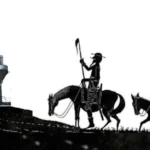
In Discourse on Colonialism, Aimé Césaire exposes the hypocrisy of the colonisers. He reminds us that it was not Cortés gazing from the top of the Teocalli pyramid, nor Pizarro standing before Cuzco, the Inca capital, nor Marco Polo in Cambuluc, the city of Kublai Khan, who ever proclaimed themselves messengers or pioneers of a superior civilisation. On their heads were helmets; in their hands, swords and muskets; in their hearts, hatred and rage. After killing people, demolishing palaces, houses, and temples, looting homes and property, and burning books, they built an entire colonial discourse upon the ruins.
While the Spanish Empire was burning the libraries of the Incas, Mayas, and Aztecs, Evliya Çelebi was recording another scene of destruction: the campaign against Bitlis and the annihilation of its great library in his Seyahatname. He joined the expedition to Bitlis in 1655. Page after page, he describes the beauty of its palaces and mansions, its vineyards and fields, the flourishing crafts and arts, the elegance of its speech and language, and the nobility and discernment of its men and women. Although Evliya Çelebi is often remembered as an anonymous traveller, he was also an Ottoman state official, accompanying pashas and ministers on their journeys and gathering intelligence for them.
Melek Ahmed Pasha, the commander of the Bitlis campaign, recognised these buildings as symbols of civilisation and autonomy. For precisely that reason, he wanted them destroyed. A battle followed. Bitlis would suffer the same fate as Tenochtitlan, Tetzcoco, and Yucatán under the Spanish: its urban fabric shattered, its symbols of independence levelled. Just as the Aztec and Mayan libraries were burned, the library founded by Abdal Khan was plundered.
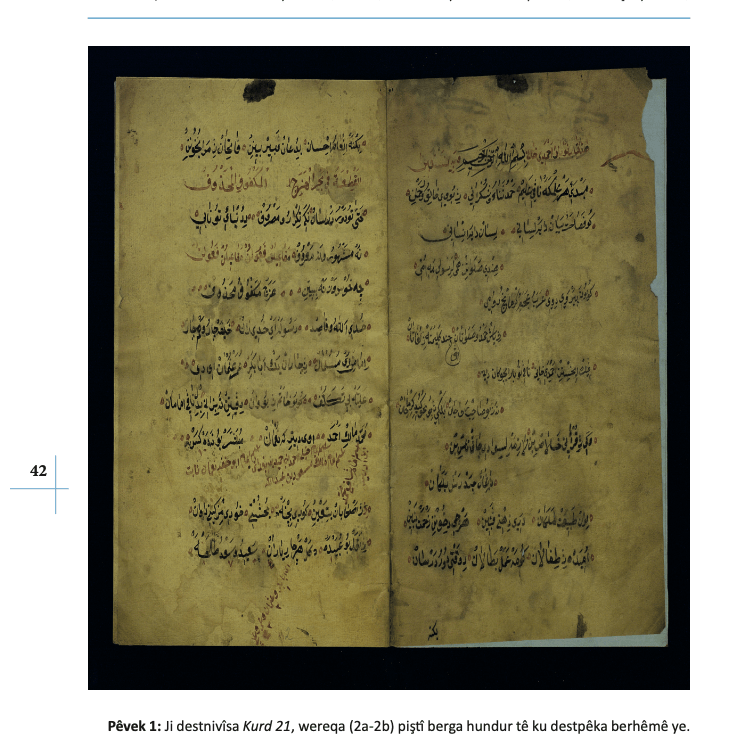
The pasha ordered the library’s books to be sold at auction. When Evliya Çelebi saw them, he was astonished by their beauty, originality, and richness. There were thousands of scientific, religious, and literary works, copied by renowned calligraphers on fine paper, along with rare manuscripts collected from distant lands. He was especially struck by the nearly two hundred books written in “infidel and foreign scripts” on atlases, geography, and anatomy, embellished with “strange” illustrations. These precious volumes were either sold off cheaply to the uninformed or lost in the dust.
When the Kurdish principalities were finally crushed in the nineteenth century, the madrasas and libraries they had sponsored were destroyed along with them. To this day, the fate of the books from those collections remains unknown. Thousands, perhaps tens of thousands, of works in various sciences have disappeared. In the vacuum created by this destruction, discourses of the “ignorant Kurd”, the “absence of urban culture”, and the “dominance of oral culture” were constructed.
In the 1850s and 1860s, as Kurdish books were left without owners and protectors, Alexandre Jaba collected Kurdish manuscripts through Mehmed Beyazidî and transported them to St Petersburg. At the same time, he claimed that the supposedly “tribal” and “indigenous” Kurds possessed a language lacking the features of a common, written medium, and that it belonged essentially to the realm of oral usage and folklore. Thus, even as Kurdish texts were being gathered and archived, new myths were being produced about their nonexistence.
In the nineteenth century, the “Poet of Freedom”, Namık Kemal, wrote the following: “If it were up to us, we would have wiped out all the languages in our country except Turkish. So why are we now giving the Circassians, Laz, and Kurds an alphabet as a spiritual weapon to sow discord among us?” Kemal, too, understood the intimate relationship between empire and language—only he voiced it as a warning against granting others the very tools of literacy and resistance.
Colonial powers destroy cities through force and violence; they close universities and madrasas; they plunder libraries. Through new schools and new books, they then seek to convince the colonised that they have no written culture, no cities, no civilisation of their own. The greater tragedy is that some among the colonised intelligentsia come to believe this and begin to see themselves through the eyes of the coloniser.
Sources mentioned
- Aimé Césaire, Discourse on Colonialism.
- Evliya Çelebi, Seyahatname (Travelogue), vol. 4, book 1.
- Serdar Şengül, on Eastern madrasas and Ottoman/Republican modernisation.
- Mesut Yeğen, The Kurdish Question in State Discourse.
- Nuri Fırat, Tribe and Rebellion: The Western Perception of the Kurds.
- Studies on Alexandre Jaba and Mehmed Beyazidî’s collection of Kurdish manuscripts.
Author Profile


#YouAreAllWeHave – Support Kurdish Media!